

Nature Club 2016 – In Cold Blood
Every season in Big Kids Club, we run at least one class that teaches kids about nature. For my first class ever, I was excited to take the Nature Club into the wide-open world of animals. But it’s a little too wide-open… We only have 12 weeks!
My goals for the season are to engender the children’s interest, of course, but also, to inspire their senses of responsibility, for the creatures in our world. Where to start…? The answer was right in front of me.
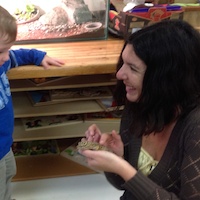 Last fall, for the first time in the 3 years since he arrived at Buddings, Gecko the Gecko got sick.
Between internet research (geckoforums.net, among others), calls to Creeg the gecko guy at Aquariums West, and insights from some Buddings herpetologist families, we began to realize that our favourite reptile was a more complicated creature than we had ever known.
 Of course we already knew that he “moults” every 3 weeks or so, because unlike people, reptiles’ skin doesn’t grow.
When his body gets bigger (from eating all those crickets) his skin splits along his sides and comes off in a few big pieces, revealing his new, bright yellow skin beneath. The skin is full of nutrients, so unless we take it out of the tank for study, Gecko eats it.
Lizards’ ability to detach the end of their tails, which continue to twitch after detachment, is a fascinating self-preservation technique, and even more exciting for many researchers, is the regeneration that occurs when the preserved animal escapes.
The writing on Gecko’s tank informed us that his tail was fat because he had released it prior to arriving in our care. We imagined him living in fear and needing to escape danger, but as we dug into our new research, we discovered quite the opposite to be true.
Geckos store their energy reserves in their tails. Our gecko had led such a safe and secured life that his tail had gained weight! What a relief.
It turned out that his fat and healthy tail helped him to survive the weeks of illness while a blockage in his digestive tract prevented him from eating… and pooping. We considered an epic bus journey to the reptile doctor in Maple Ridge, but in the end, I was able to move the “impacted feces” through his system by massaging his tummy while he stood in a warm bath (stranger, even, than it sounds…), and finally to remove it with tweezers. Phew.
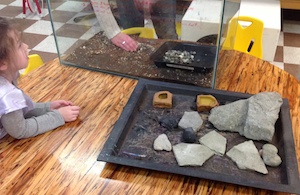 We discovered that the sand substrate in his tank was the problem. He had swallowed some, when he lunged at a cricket.
And then we learned that his tank should have at least two different substrates, anyway. A dry, heated side allows him to bask, and a cooler, humid side where he can rest.
Reptiles don’t maintain a regular internal temperature, so he depends on his environment to warm and cool his body.
So, we redesigned the tank, and set up a thick coconut fibre layer with a hide, and a desert carpet, with a sandy surface that was glued down, so he can’t swallow it.
All this research has made us more informed care-givers for our creatures, and it gave me a great idea for narrowing my Big Kids Club topic.
Starting this Wednesday, and throughout the Winter Season, we’re taking a cold-blooded look at the habitats and histories of the not-so-cute creatures we call pets.
Did you know that today’s reptiles are descended from creatures that lived before the dinosaurs?
That the amazing migrations of our provincial fish have inspired myth and legend among West Coast native cultures?
Or that frogs can change gender in response to population needs, as well as after exposure to certain herbicides?
If the world is going to remain our oyster, for future generations to enjoy, we need to learn to make better, more informed decisions about its care. That’s what Nature Club is all about.

